






AI Product Manager
shipping at scale.
Ten years building software where the cost of failure is real: 911 dispatch handling 12% of US emergency calls, FDA-pending AI for 3.5M dermatology patients, and a 4-person team rebuilding a 1,500-hotel SaaS via a 55-agent AI Product Development Lifecycle that ships in days, not months.
Reading
The compounding asset
AI
AI Product Manager who codes
PM
Full lifecycle, first-principles
Mind palace
The structuring craft
Selected work
Three projects, one throughline.


How I work
- Simplify ruthlessly. ICC dispatch: 22 commands → 1, US patent. UKPass: 5-tab feature buffet → 3-tab guided experience. MoleSafe: 2-hour patient imaging → 20 minutes; per-lesion diagnosis → 7 seconds. The job isn’t adding features — it’s deleting them with intent.
- Customer obsession is field work — physically. For MoleSafe I rented mannequins, set up a stopwatch, and reproduced the competitor’s workflow end-to-end in the office; every step over a second got tagged for elimination. For ICC I rode along on 911 calls and ran design-thinking sessions with first responders before writing the integration spec. For DermDx I travelled to Australian clinics — the world’s highest melanoma incidence per capita — before proposing architectural changes.
- Process is the product. When a four-person team has to outrun a hundred-person team, the cycle has to compress. I designed the AI Product Development Lifecycle at Valsoft — 55 agents, 26 skills, 5 orchestrators, typed handovers, quality gates — and ran it to ship 7+ major launches in six months at ~10× conventional velocity. Process is the unfair advantage when the team isn’t.
- Own the data and the workflow. DermDx ran a multi-year FDA submission and the platform roadmap on the same source of truth — model improvements landed in submission packets within days. The AI Support Agent’s 5-layer safety pipeline (PCI guard, PII redactor, hallucination guard, output guard, escalation gate) was non-negotiable from the first PRD, not bolted on after a demo. Models get replaced; the pipeline and the workflow don’t.
- Ship complete, not MVP’d. Indie iOS apps (UKPass, CANPass, FAA Part 107 / PPL) ship with full feature parity at v1.0 — no MVPs, no staged rollouts, no v0.x.y backlog. The alarm-to-PSAP integration on Spillman Flex went live across three states during COVID after seventeen protocol iterations. roomMaster Web App launched and DAU jumped 700% on day one because the Housekeeping PWA had already pressure-tested the API end-to-end. Tight constraints make the design choose itself.
Product Management playbook
A living mind map of the seven-stage product lifecycle I run by default — Discover, Define, Design, Develop, Deliver, Debrief, Depart — with the artifacts and activities that anchor each stage. Each stage has its own typed outputs (intent docs, PRDs, ADRs, work breakdowns, launch plans, retros, sunset comms) and quality gates between handovers, so a feature never moves forward on a meeting; it moves on an artifact.
Built over years of shipping in regulated AI, healthcare, and hospitality, then continuously edited as the work taught me what to keep and what to throw out. The MoleSafe redesign, the DermDx FDA submission, the AI PDLC at Valsoft, and every indie iOS release all ran through this same skeleton — different domain, same backbone.
AI Engineering map
The surface I work across as an AI Product Manager — foundation models, evaluation, prompt engineering, RAG and agents, finetuning, dataset engineering, inference optimization, and the five-step production architecture (context → guardrails → model router → caches → agent patterns) all held in one canvas. Keeping the whole thing visible is how a model decision in week one stops getting rediscovered as a production incident in month six. My approach is mechanical: every node has to earn its place by showing up in a shipped artifact, otherwise AI work drifts into “we have an LLM somewhere.”
Same map shipped the AI PDLC (55 agents, 26 skills, 5 orchestrators), the AI Support Agent’s 5-layer safety pipeline, the AI Concierge’s tool-using booking agent (+35% bookings, +60% CSAT), and Ampliphi’s hybrid forecasting + LLM pricing. Different products, same map. Spine of the structure is Chip Huyen’s AI Engineering; the rest is what production added.
Speaking
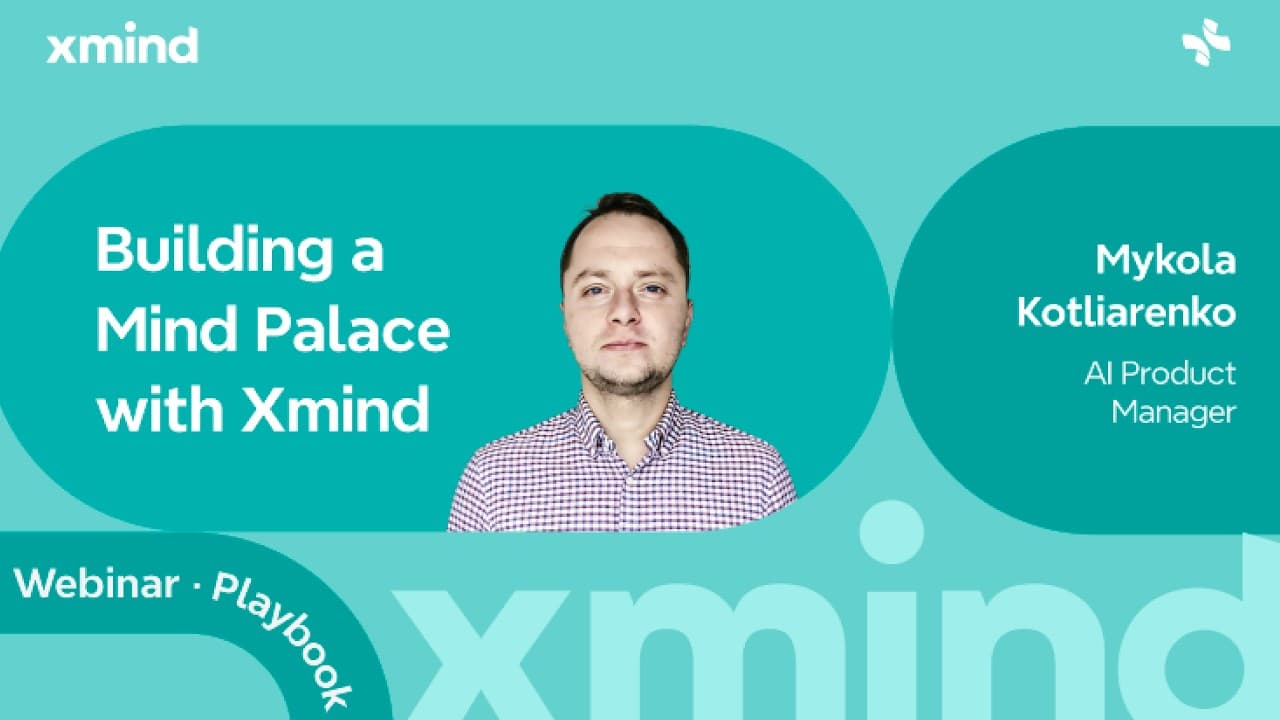
Xmind Ambassador for visual thinking — one of a small global cohort the Xmind team picked for using mind-mapping at production scale across product, AI engineering, and personal knowledge. The mind palace isn’t a metaphor: it’s the method of loci — a 2,500-year-old memory technique — fused with the Krebs Cycle of Creativity and rendered in Xmind. Hundreds of books become a queryable second brain; the same graph ships the PM playbook and the AI Engineering map above. The webinar on the right walks through the practice.
Off the clock
I read a lot — engineering, AI, mathematics, cognitive psychology, economics, systems design. Each book gets mind-mapped, cross-linked into the palace on the right, and pulled back the next time a problem walks in. Off the desk it’s running, camping when the weather plays along, and most of the work happens with music on.
The indie iOS work lives in the same off-the-clock space — apps shipped solo, end-to-end, on the same playbook as the cases on /work. It’s the test rig where the playbook gets stressed in isolation: no team to compensate for a weak spec, just the playbook and a deadline. Also an open-source contributor to ScreenPipe.
The career, mind-mapped
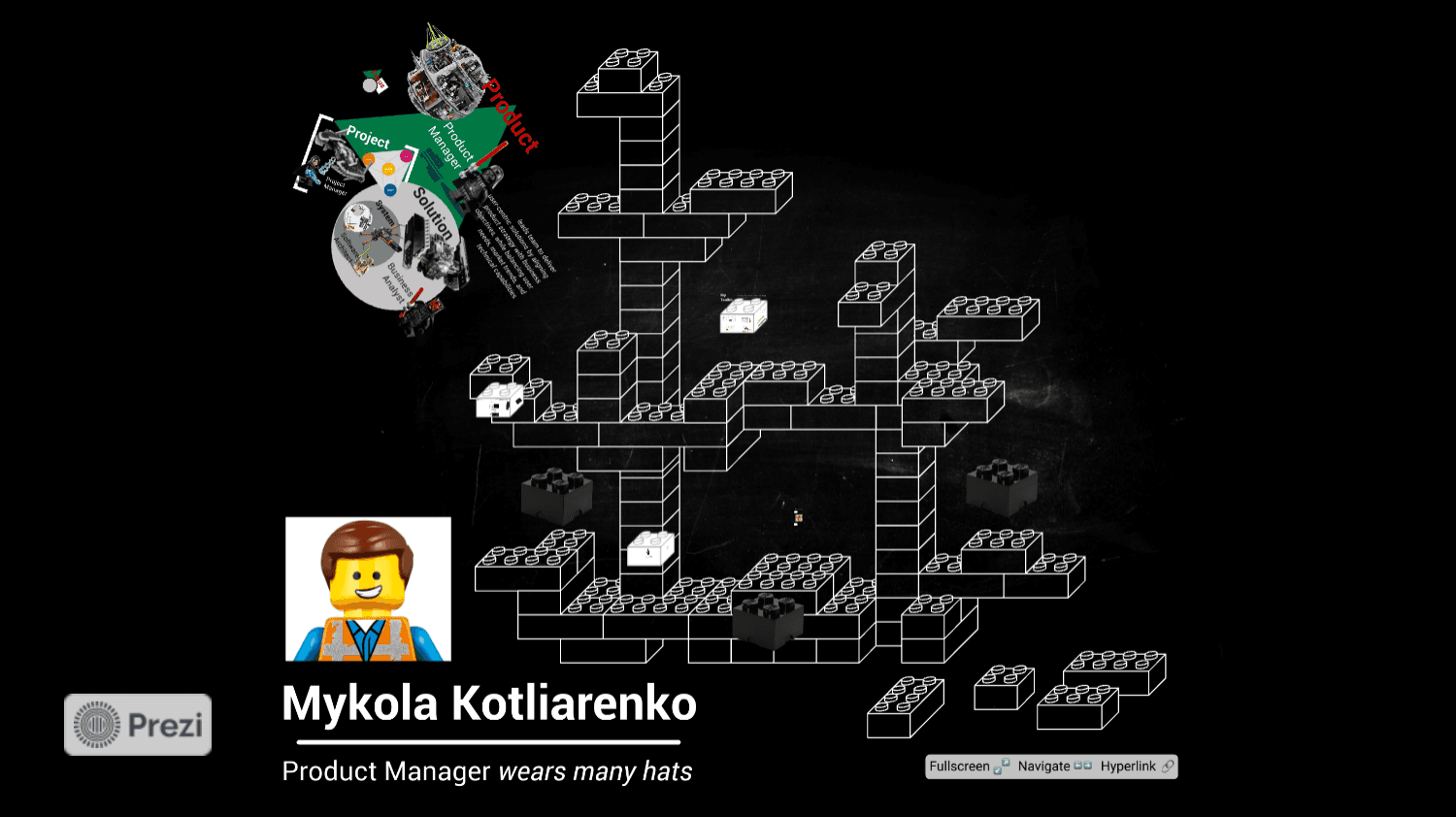
The maps above structure problems; this Prezi structures a career as one continuous arc instead of a résumé bullet list. Four industries, ten years, drawn as a single canvas — Motorola public safety → Copperleaf enterprise AI → MetaOptima healthcare AI → Valsoft AI PDLC — with the throughlines drawn explicitly between them. The camera pans through the connections so you see how a 911 dispatch decision in 2018 shaped an AI portfolio optimizer in 2022, an FDA submission in 2024, and an AI Product Development Lifecycle in 2026.
If you want to see how I’d frame a complex decision in a room — five minutes, no slide deck, a canvas and a pointer — this is the closest thing to that live experience that fits on a webpage. Open it full-screen.